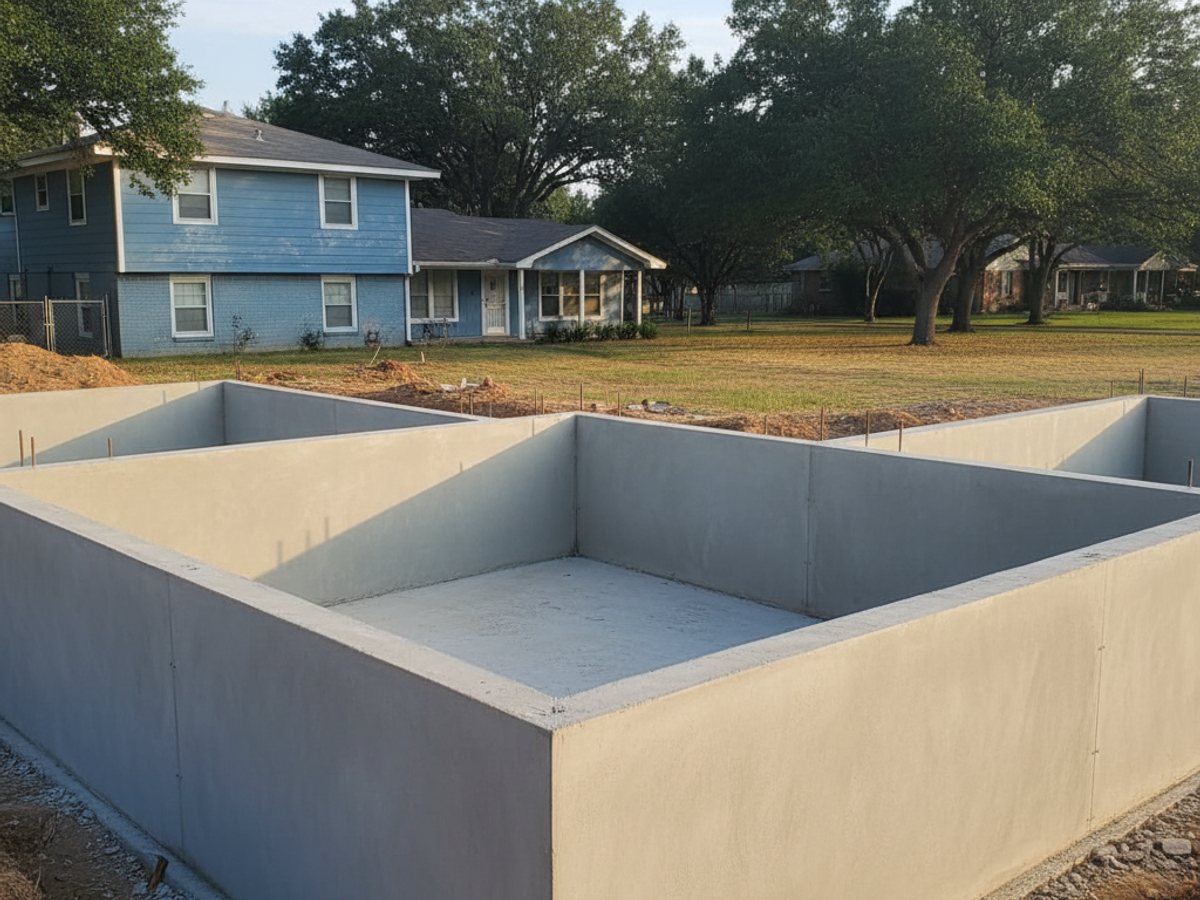
Most people call a concrete contractor once they know what they want poured. Fewer people ask what's going to happen to that concrete after it's down. In McKinney, the ground and the weather both have opinions about that, and so does the city. Here are ten things worth looking at before anyone shows up with a mixer truck.
What's actually in the ground
McKinney sits on Blackland Prairie soil, mostly Houston Black and Burleson clay. This clay has a high shrink-swell rate, which means it holds water like a sponge in a wet spring and pulls away from itself in August when it dries out. A slab poured on clay that hasn't been properly compacted will show it within a year or two, usually as a crack running toward the low corner of the yard. Before any pour, ask what's being done to the subgrade. A few inches of compacted base material under the slab matters more than most people think, especially on a patio or driveway that doesn't have a foundation footing to lean on.
If your house is in one of the older sections near Historic Downtown McKinney, there's a decent chance of old clay sewer pipe, cast iron, or an abandoned septic line somewhere under the yard. Nobody wants to find that out mid-pour.
Where the water goes
Flat lots and clay soil are not a great combination for drainage. Water that can't soak in has to run somewhere, and in a heavy spring downpour, which McKinney gets plenty of in April and May, that somewhere needs to be away from the house. A driveway or patio should slope roughly a quarter inch per foot away from the foundation for the first several feet. If the new slab ties into an existing low spot in the yard, that problem doesn't go away, it just gets a concrete surface to sit on top of. Worth walking the yard after the next real rain and seeing where the water actually pools before anyone pours anything.
Permits, surveys, and the HOA
The City of McKinney requires a permit for most slab work, including driveways, and work that touches the public right-of-way, like a driveway apron or a sidewalk along the street, usually needs its own review. Call 811 before anyone digs. It's free, and it's how Atmos gas lines, buried irrigation, and cable get marked so nobody cuts through one with a trencher. If you're in a newer subdivision like Stonebridge Ranch, Trinity Falls, or Tucker Hill, check the HOA rules too. Some have specific requirements on driveway width, stamped patterns, or even concrete color, separate from whatever the city requires.
A quick setback check is also worth doing if the new concrete is going near a property line, especially for a retaining wall or an addition to an existing patio. It's a lot cheaper to check a plat than to find out later the wall sits a foot into the neighbor's side.
What the slab itself needs
Not all concrete is the same thickness for a reason. A sidewalk or a patio usually runs 4 inches thick. A driveway that has to carry a truck or an RV needs 5 to 6 inches, and it needs steel in it, either rebar on a grid or welded wire mesh, to keep a crack from turning into a gap. Rebar, typically a #3 or #4 bar set 18 to 24 inches on center, does more for load-bearing areas like a driveway or a garage floor slab than mesh does, since mesh tends to sink to the bottom of the pour if it isn't chaired up properly.
Control joints matter too. These are the straight lines cut into a slab every 8 to 12 feet, usually within 24 hours of the pour, so the concrete has a planned place to crack instead of picking its own. A contractor who skips this, or cuts the joints too shallow, is setting up a random crack somewhere down the line.
Timing and the McKinney calendar
Concrete cures by a chemical reaction, not by drying out, and McKinney's weather pushes that reaction around more than people expect. In July and August, with highs regularly past 95 degrees, fresh concrete can flash set on the surface before it's finished curing underneath, which leads to surface cracking and dusting. A good crew will water-cure or use a curing compound and may push the schedule to a morning pour. On the other end, a hard freeze in December or January, while not common, can crack a slab that was poured too late in the day without any cold protection.
Plan on roughly 24 to 48 hours before foot traffic on a new slab, about 7 days before it can handle a car, and closer to 28 days before it's at full strength. Rushing a driveway open for a moving truck at day 3 is how driveways end up with tire-shaped cracks.
A few other things worth a look
- Mature trees on older streets, especially oaks, have roots that will lift a sidewalk or driveway edge over time. Removing or routing around them is worth discussing before the pour, not after the lift shows up.
- Existing concrete being replaced needs to actually come out, not get poured over. A thin topping over a cracked slab just telegraphs the same crack back through in a season or two.
- Ask how the old concrete gets removed and hauled off, and whether that cost is already in the quote.
None of this is complicated, but it's the kind of thing that separates a slab that holds up for 30 years from one that's cracked by year three. If you're weighing a driveway, a patio, or a foundation slab in McKinney and want someone to walk the yard with you before anything gets poured, that's the kind of conversation All Things Concrete Co has with homeowners all the time.